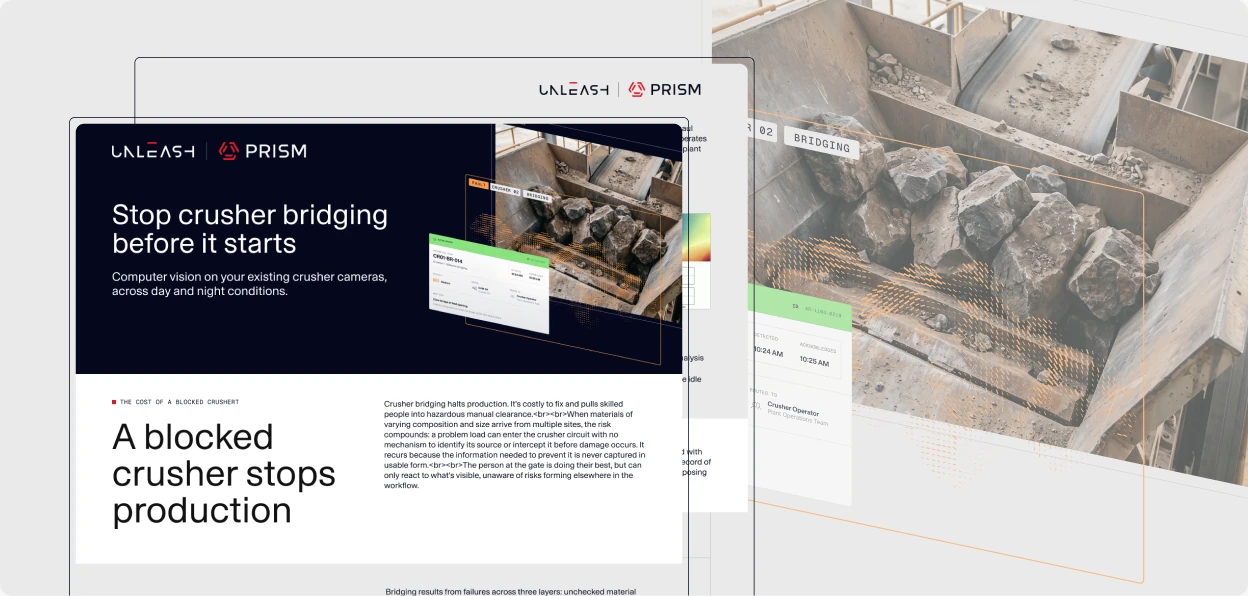
Flag oversize loads at the face, sequence every truck and catch bridges as they form, before throughput stops.
- Resources
A bridged crusher stops the plant, and clearing it sends skilled people into hazardous manual work. At one major iron ore operation, bridging caused 7 hours of delays and 30,000 tonnes of lost feed in two weeks. Mixed ore from different faces raises the risk, and without a record of what came before each bridge, the same blockage keeps coming back.
This brief shows how Prism, Unleash Live's continuous monitoring across concentrated, high-activity sites, watches every load from face to feed using standard cameras at the crusher and along the haul approach, with a compact edge unit on site. Prism checks each tray for oversize as the excavator loads it, classifies the material on every truck in the queue so problem loads don't arrive back to back, and uses depth analysis on the feed opening to detect a bridge as it forms.
Inside the brief:
- Where bridging starts at the face, at the gate and in the pit, and why fixing one layer leaves the other two exposed
- How load classification feeds your existing sequencing logic and your PLC and SCADA controls
- What gets logged for every classified load, flagged truck and bridging event, and how that record traces each bridge back to the faces, shifts and load sequences behind it
- How Prism is validated on your own footage, day and night, before it goes live
Written for primary crusher, plant operations and site productivity leads. Download the full solution brief to see how to stop crusher bridging before it stops you.

