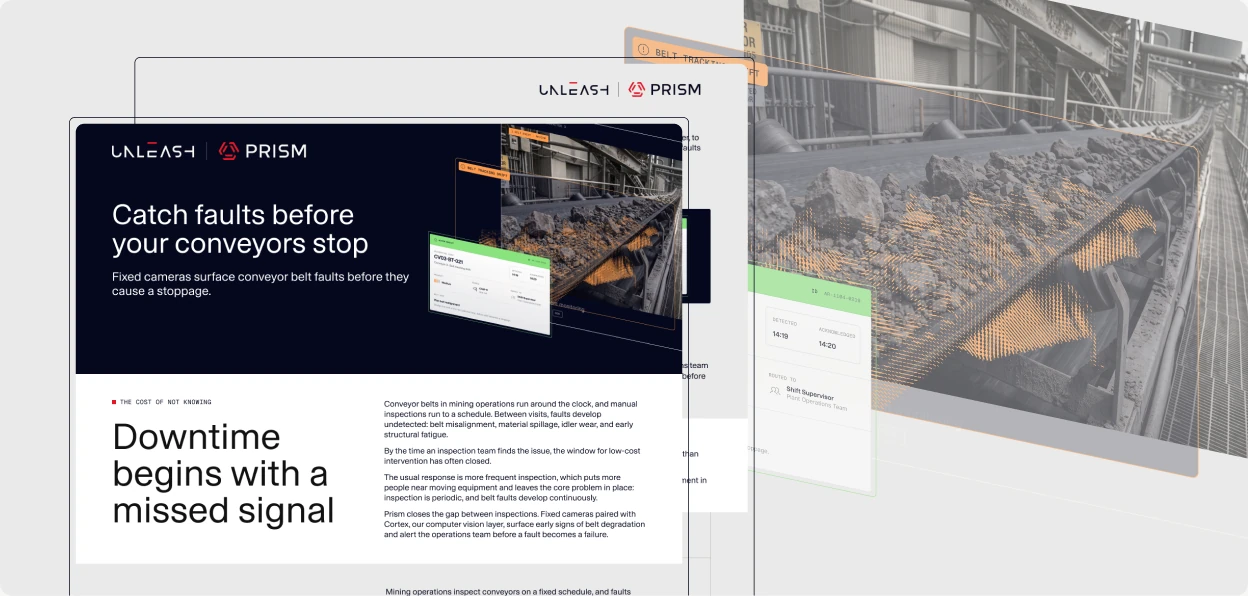
Fixed cameras catch belt drift, chute build-up and oversize loads between inspections, before a fault stops the plant.
- Resources
When a main conveyor stops, the plant behind it stops too. Belts run around the clock while inspections run to a roster, so faults grow in the hours between rounds. One mining and processing operator calculated that every 5% of conveyor run time lost costs $1.3M a year in throughput, and sending crews out more often only puts more people beside moving equipment.
Belt drift switches trip only when the belt is already at the edge of the rollers, and chute sensors fire once the chute is full. This brief shows how Prism watches belt condition on the cameras you already run, picks up belt drift, chute build-up and oversize loads as they develop, and sends each alert to operations with video and location while the fault is still minor.
Inside the brief:
- What happens to a belt between inspections, and why existing switches and sensors report the stoppage instead of the fault building
- Results from a deployment at a mining and processing operation, where Prism recorded six congestion events in a single shift
- How alerts from standard RTSP and ONVIF cameras feed your PLC, SCADA and PI historian, with processing on site
- How to start on one belt, validate against agreed accuracy targets and expand as results prove out
Written for maintenance, processing plant and throughput leads. Download the full solution brief to see how earlier detection turns an emergency repair into a planned stop.

