An evaluation framework for energy and mining operators assessing computer vision for continuous safety monitoring, including the questions most buying processes miss.
- monitoring
- safety
- computer-vision
- ai
- operations
- mining
- oil-gas
- integration
An evaluation framework for energy and mining operators, including the questions our own answers do not always win.
By Hanno Blankenstein, Global CEO & Co-Founder, Unleash Live
The cameras are already there. Most energy and mining sites have had fixed CCTV for years, covering plant, gates, conveyors, tank farms and haul roads. The footage records continuously and almost none of it is watched until something has already gone wrong and someone goes looking for it.
That is the opening every computer vision vendor uses, this one included, and it is true. What follows it is usually a demonstration: a hard hat detected, a person in a restricted zone, a box drawn on a frame. The demonstration always works. It is the part of the problem that was solved several years ago.
The reason so many of these programs stall after the pilot is that the evaluation tested the wrong thing. Detection accuracy on a vendor's reel tells you very little about whether a system will still be running in eighteen months, whether anyone will trust its alerts by then, or whether a single incident report will be any easier to produce than it was before.
Below are the questions worth asking instead. They are organized by who in your organization owns the answer, because these programs are bought by three groups at once and each one is accountable for something different. Content aimed only at the engineers is how a program ends up technically sound and commercially stranded.
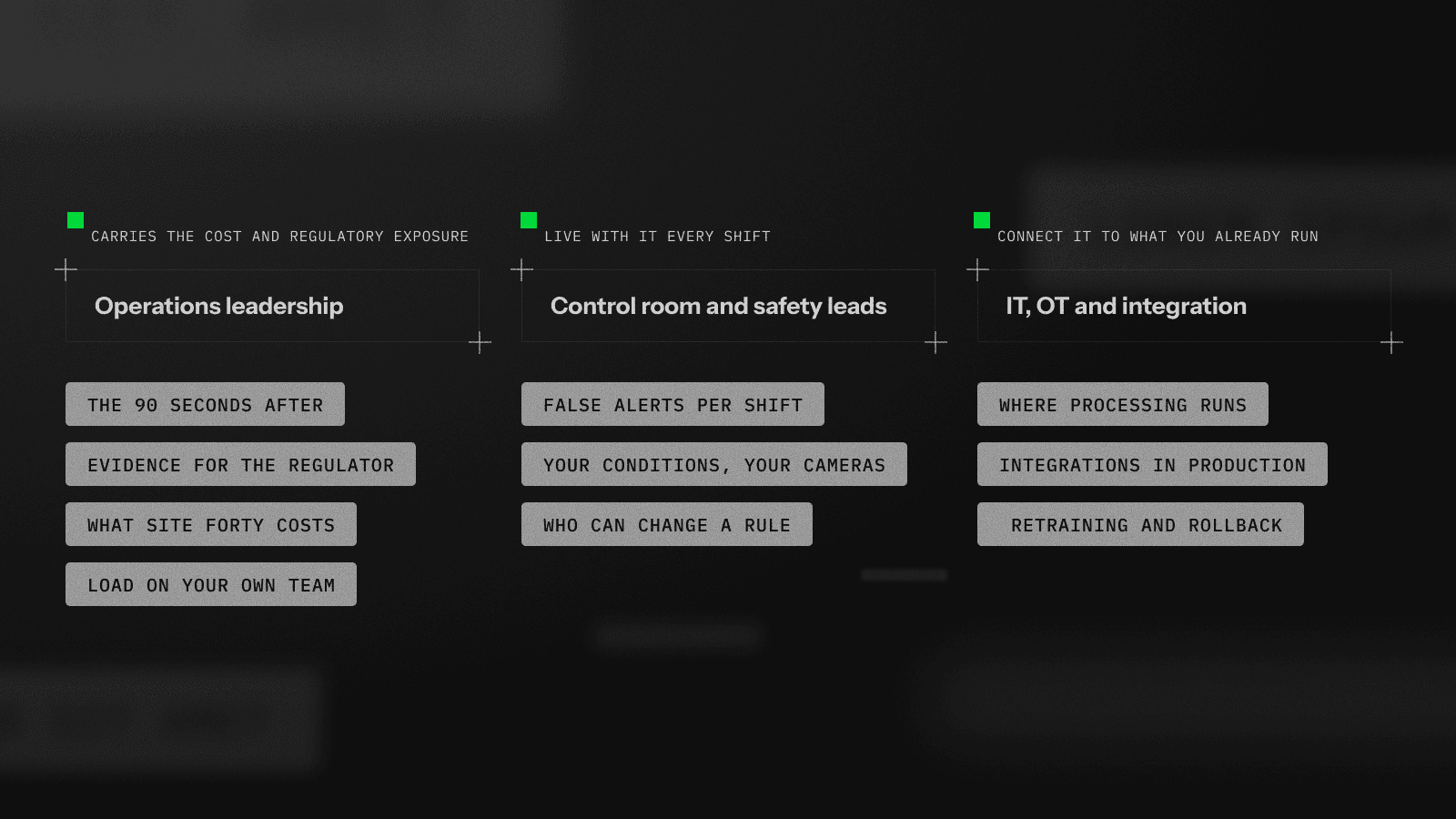
Questions owned by whoever carries the cost and the regulatory exposure
1. What happens in the ninety seconds after a detection?
Ask the vendor to walk the whole path, not the detection. Who is told, through what channel, on what device, and what are they expected to do. Does the event become a work order in the maintenance system, or a line in a dashboard that someone reviews on Thursday. A detection that reaches nobody with authority to stop the conveyor has changed nothing about your risk. This is the single question that separates a monitoring program from a video archive with better search, and most vendors answer it with a screenshot of a notifications panel.
2. What does it produce when the regulator asks?
After a serious incident you will be asked to show what was known, when, and what was done. The question for the vendor is what the system can produce six months later: the original footage, the detection record with its timestamp and model version, who reviewed it, and what action followed. Ask whether that record survives a model update. Ask what happens to it when the retention window expires. A summary report is not evidence. The underlying record is, and some systems do not retain one in a form that holds up.
3. What does site forty cost after site five?
Pilot pricing tells you nothing. Get the commercial model: per camera, per site, per detection, per seat, or flat, and what happens when you add a hundred cameras to an existing site rather than a new site. Per-detection pricing in particular behaves badly in mining, where a dusty lens on a haul road can generate thousands of events a week. Ask what the renewal looks like in year three and whether the model changes if you move processing on-site.
4. What does your own team have to do to stand it up?
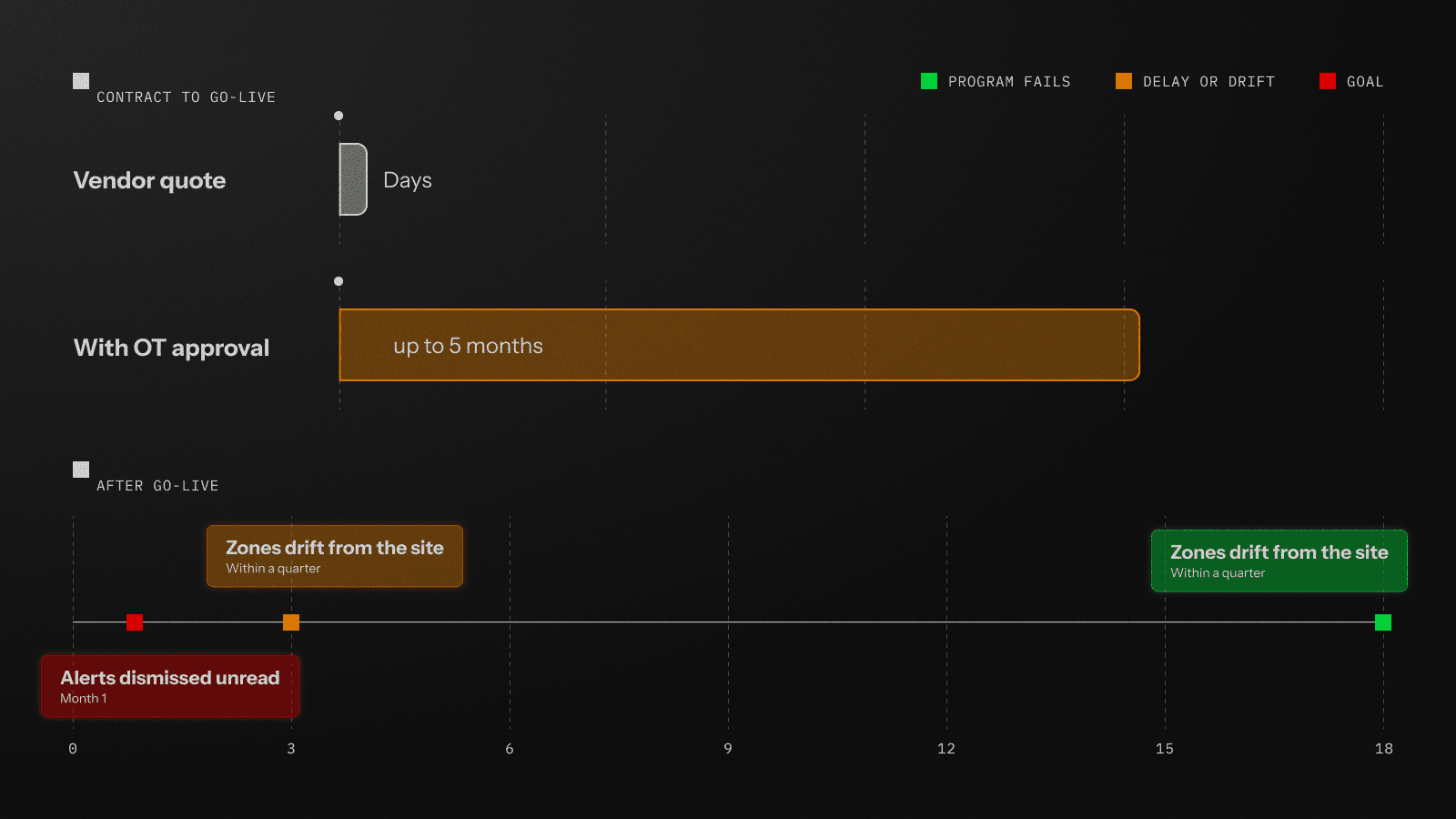
Vendors quote their own deployment time. The number you need is the load on your people: the camera survey, the network and OT access approvals, who defines the zones and thresholds, who signs off on connecting anything to the control network, and how long your security review actually takes. In our experience the OT approval is the long pole and it is almost never in the vendor's timeline. A system that goes live in days on paper can sit for five months waiting on a network change.
Questions owned by the people who live with it every shift
5. What is the false positive rate, in alerts per camera per shift?
Accuracy percentages are unusable without this. A figure like 98 percent sounds strong until you apply it across two hundred cameras running continuously, at which point the absolute number of wrong alerts per week is very large. Alert fatigue is the most common way these programs die: the control room starts dismissing without looking, and within a month the system is running and nobody is reading it. Ask for alerts per camera per shift, and what proportion a reviewer dismisses. Most vendors have not measured it. The ones that have will tell you, and that answer is worth more than any accuracy claim.
6. Does it hold up in your conditions, on your cameras?
Dust, glare, rain, steam, night lighting, a camera that was mounted for a different purpose eight years ago at the wrong angle. Ask for detection performance from a site that resembles yours, not a demonstration environment. For mining specifically, ask what happens to detection quality as a lens degrades between cleans, and whether the system can tell you it has degraded. For energy, ask about thermal and about assets that are small in frame at distance. Then ask them to prove it on a week of your own footage before you commit to anything.
7. Who can change a rule on a Tuesday?
When a work area moves, somebody needs to redraw the restricted zone. If that requires a vendor ticket and a two-week turnaround, your supervisors will work around the system rather than with it, and the configuration will drift out of step with the site within a quarter. Ask whether a safety lead can do it themselves, what training that takes, and what happens to the program when the one person who understood the console leaves. This is where the self-service products are genuinely stronger than the enterprise ones, ours included.
Questions owned by whoever has to connect it to what you already run
8. Where does the processing run, and where does the data sit?
A remote pit or an offshore facility with intermittent connectivity cannot depend on a cloud-only architecture, and a system that stops detecting when the link drops is not continuous monitoring. Ask what runs on-site, what the system does during an outage, and what it does when the link returns. Separately, ask where the footage and the detection records are stored, in which jurisdiction, and whether that can be constrained to your own infrastructure. Operators who ask this question late tend to discover it after the architecture is already set, and the rework is expensive.
9. What does it connect to, with documentation?
Asset management is the obvious one, SAP PM or IBM Maximo. Ask also about the historian, the permit-to-work system, the CMMS and the alarm or SCADA environment, and in each case ask whether a real customer is running that integration in production or whether an API exists in principle. The difference between a documented, deployed connector and a published API is several months of your integration team's time. Ask which customers are running it and whether you can speak to one.
10. Does it get better on your site, or is it fixed?
A model trained on somebody else's plant will underperform on yours, and the gap does not close on its own. Ask whether there is a retraining loop using your operational data, who runs it, how often, and what it costs. Ask whether model versions are tracked, so a detection from March can be traced to the model that produced it, and whether a model update can be rolled back when it makes things worse. A vendor who cannot answer the rollback question has not run this at scale.
On the market, briefly
There are now a reasonable number of credible products in this space and they are not interchangeable. Several are built around warehousing, logistics and discrete manufacturing, where the environment is indoor, well lit and comparatively stable. Several are built for construction sites. A smaller number are built for process plants and heavy industry, where the conditions are harder and the integration surface is larger. The marketing material reads similarly across all of them. The deployment references do not, so ask for references in your own industry and on your own scale, and discount everything else.
It is also worth asking what a vendor declines to claim. A product that is honest about where it is weak is usually further along than one that scores itself full marks against its own criteria.
Hanno Blankenstein is Global CEO and Co-Founder of Unleash Live, an enterprise computer vision company whose Prism product competes in the market described above. The questions here are the ones he believes buyers should ask.

