Five of the eight stages in an enterprise inspection cycle are automated. The three that need a crew on site cost 16 days. Here is what closes them.
- inspection
- drones
- operations
- utilities
- transmission
- ai
An enterprise inspection cycle runs eight stages, and five of them are already automated. Planning, capture, analysis and review have each been compressed over the past decade by software. The three stages that need a person standing at the asset have not moved, and on a mature program they now set both the cycle time and a large part of the cost.
For an operator running assets across a state or a country, those three stages are the reason inspection work gets booked months ahead of the need rather than against it. Inspecting on demand stops being available at all, because the schedule decides when someone flies, not the asset.
What are the stages of an inspection cycle?
A job runs the same eight stages every time. A need is raised. The work is planned. The resource is booked, which means a crew, access to the asset and a flight approval. The crew deploys. They capture. The data is analyzed, the findings are reviewed, and someone acts.
Track those stages across the last decade and each wave of automation lands on a different one.
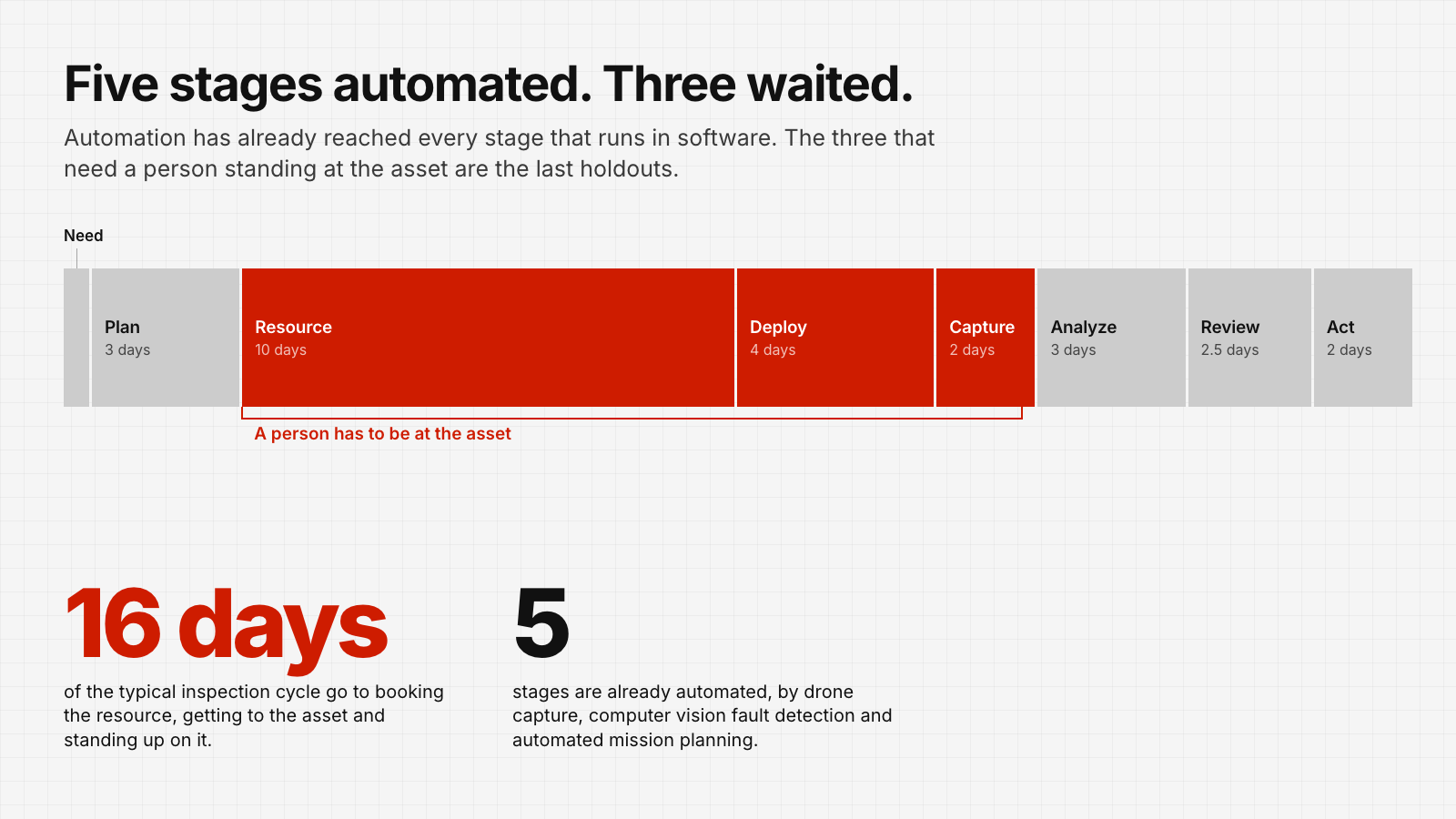
Five are automated. Three are not, and they are the three that need a person standing at the asset.
Why did five stages automate and three hold?
Drone-based capture took capture from days of rope access and elevated work platforms to a few hours, and multiplied the data behind it, so analysis got slower before it got faster. Computer vision fault detection fixed that: AI Apps read the capture and return detected faults without a person scrolling thousands of frames. Automated mission planning then took planning down, because an inspection became a job you task rather than a program you write.
Those advances share a property. Each one automated something that happens in software or in the air, and none of them required a change on the ground.
The three stages that held are bound to a person physically arriving at an asset. Better software does not compress a four-hour drive, and better analytics do not shorten a site induction. The approvals attached to that arrival exist because a person is entering a hazardous area, so they scale with the number of visits rather than the number of flights. That is why they held while everything around them automated.
What does getting to site actually cost?
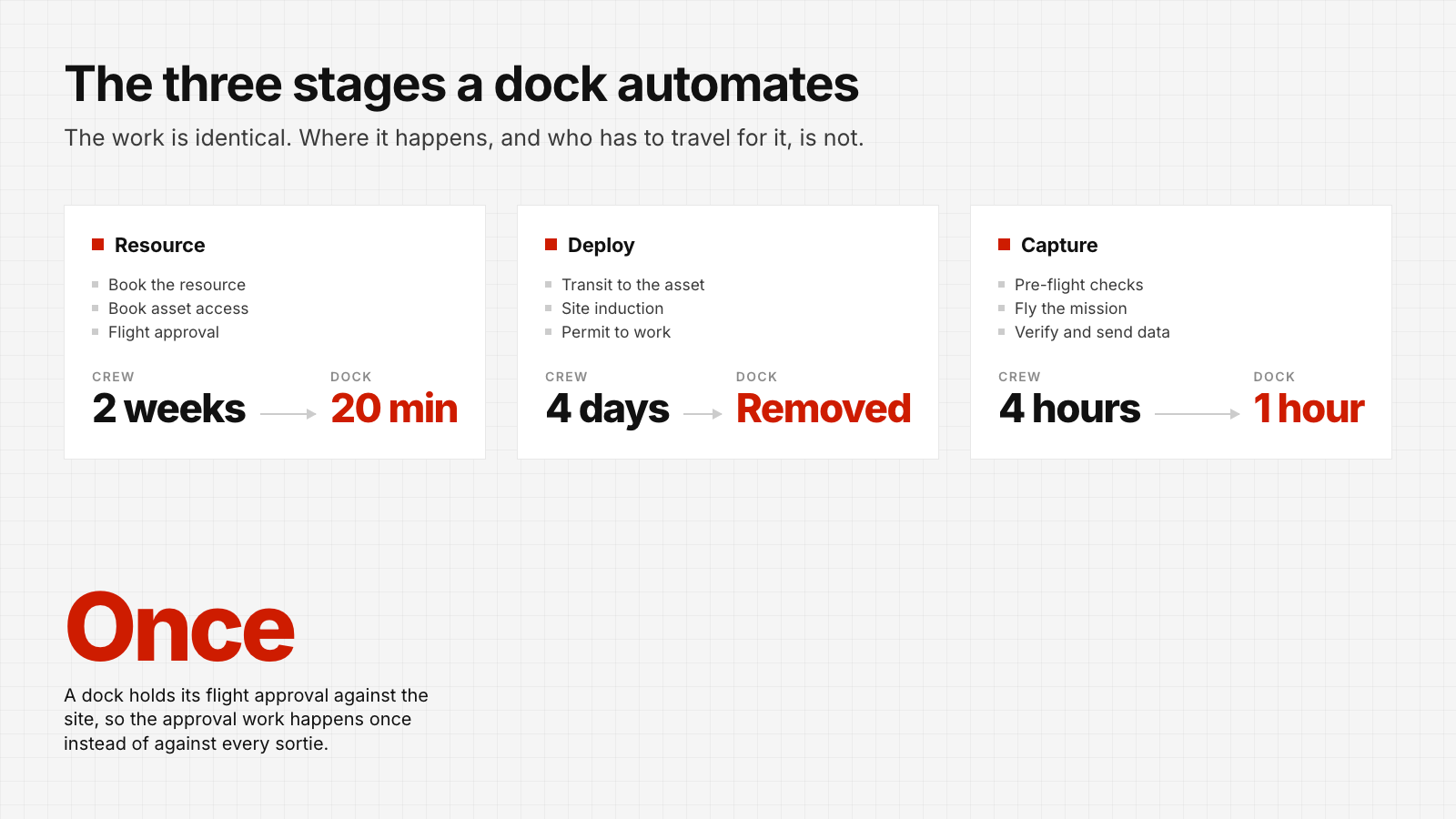
Booking the resource is the largest single block in the cycle. It is not the flying and it is not the analysis, it is waiting for a crew, an access window and an approval to line up in the same week. Deploying adds the transit, the induction and the permit to work. Only then does anyone capture anything.
Three costs sit on that run, and they compound.
Operating cost. Field time is the largest controllable line in most inspection budgets, and most of it is travel and site access rather than capture. A dock stationed at the asset moves that spend onto equipment you can depreciate, which shifts inspection from an operating cost to a capital item. Finance teams find that conversation easier than the one about headcount.
Schedule risk. Inspection intervals are a compliance obligation rather than a preference. When getting to site forces work to be booked weeks ahead, the schedule absorbs the slack, and an unplanned inspection displaces planned ones. Every urgent job you insert costs you a scheduled one.
Personnel exposure. Every induction and permit to work exists because a person is entering a place that can hurt them. Those controls manage the risk without removing it, and the hierarchy of control is clear that elimination sits above mitigation. Getting to site has been the stage where elimination was unavailable, because somebody had to drive out and fly.
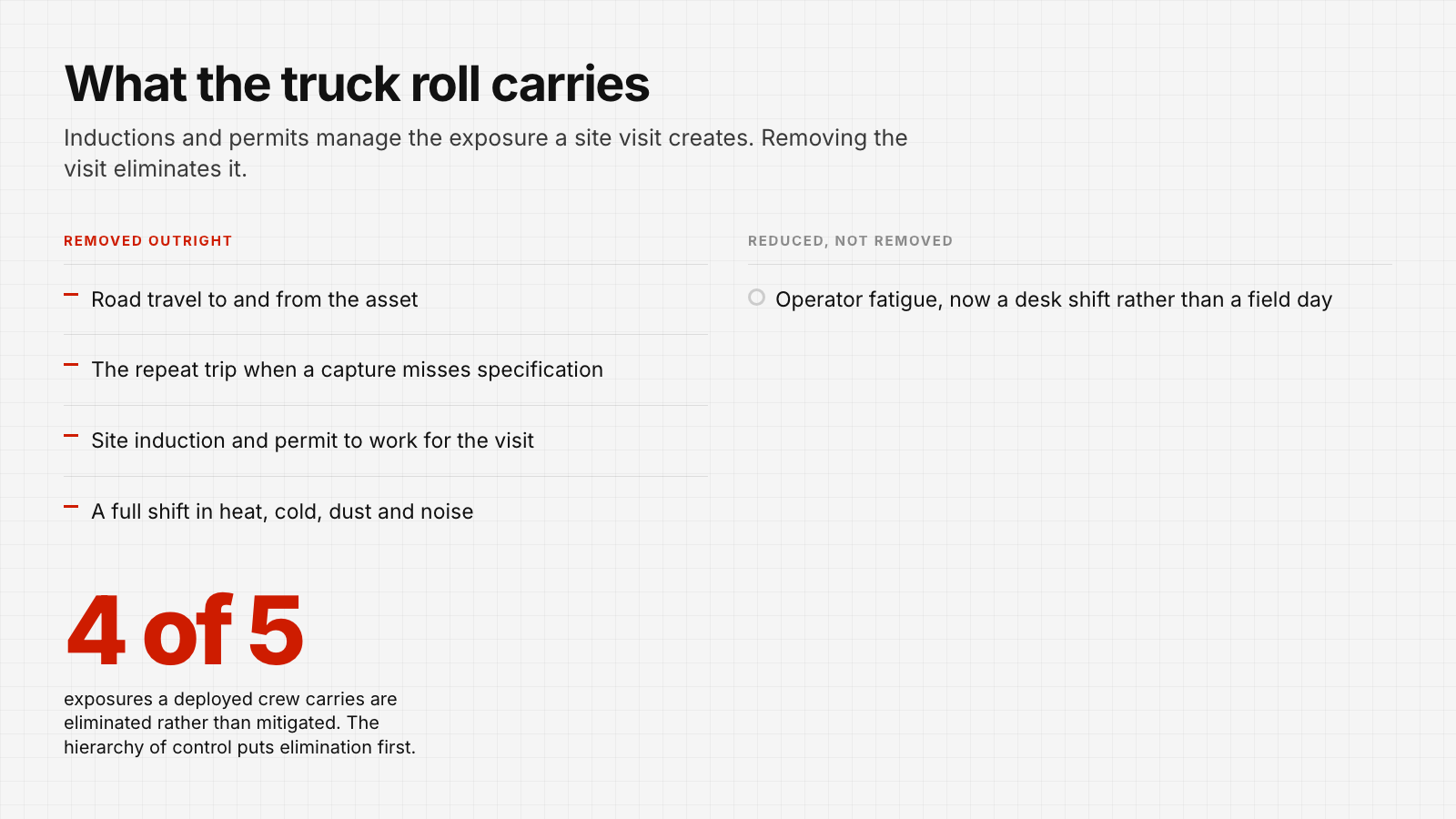
Road travel deserves the most weight. For distributed infrastructure the crew spends more time driving than capturing, and driving is the highest-frequency hazard in the whole program. A second trip, triggered when the capture missed the specification and nobody found out until the data reached the office, doubles that exposure for no additional output.
What about the flight approval?
The standard objection to a dock is regulatory: that standing up beyond visual line of sight operations is slow enough to expire the efficiency case before the program starts.
The part of that worth arguing is where the approval attaches. A crew-based program books an approval against a sortie, so the approval work repeats every time you fly. A dock holds its approval against the site, so the work happens once and every later flight runs underneath it. The first flight is the slow one. The hundredth is not.
First-of-kind approvals for drone-in-a-box operations beyond visual line of sight have already been granted in Australia, so this is a question of process rather than precedent. Ask your regulator what a site-based approval takes for your asset class, and compare it against what you currently spend on per-sortie approvals in a year.
What changes when the drone is already at the asset?
The stages do not change. AutoDock turns a dock already standing on your site into an automated capture point for Orb inspections, run from any authorized browser, and the pipeline runs automated from a job being raised to a finding being reviewed. The asset is digitized and analyzed around the clock, with nobody on site.
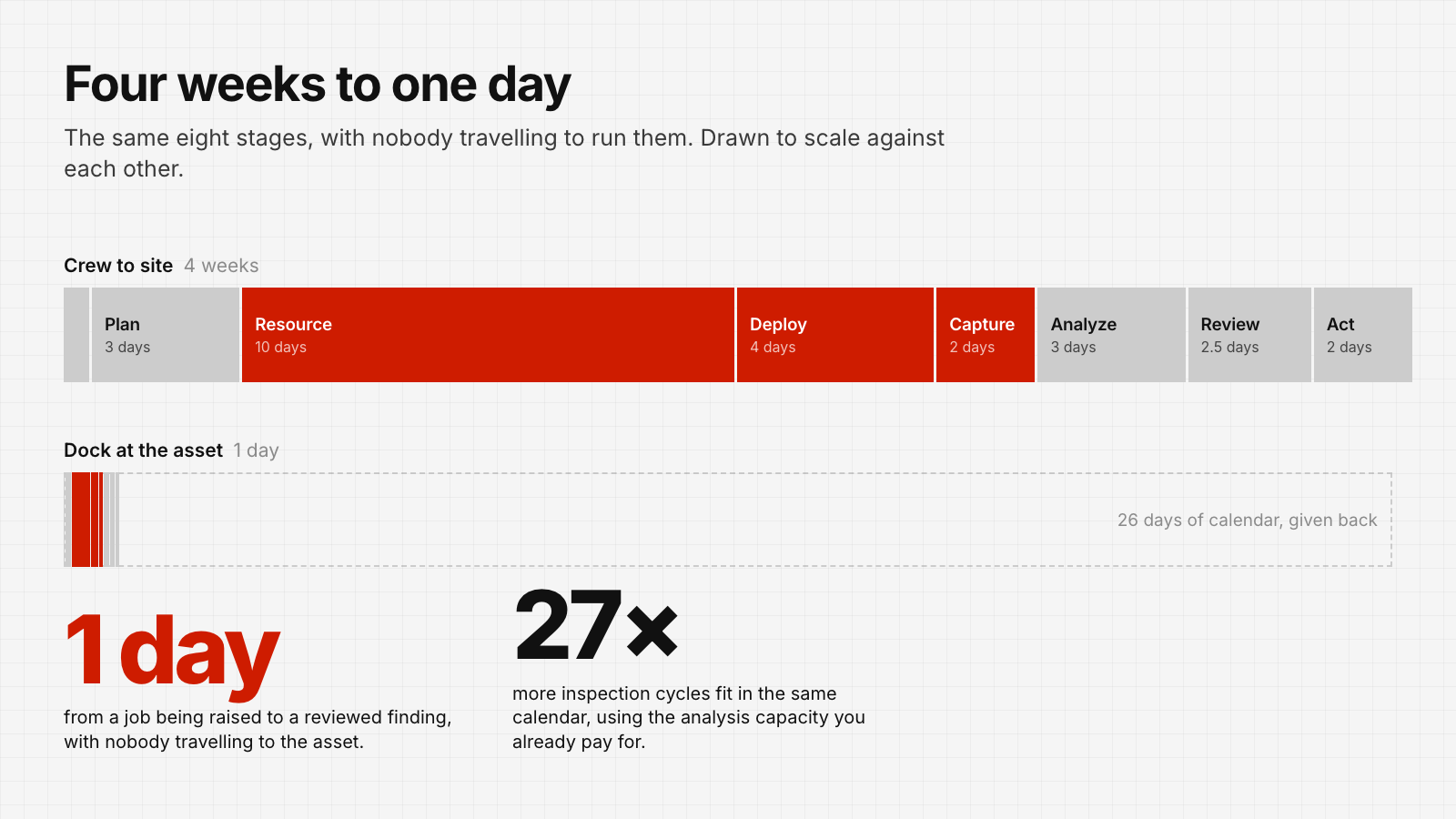
The sequence becomes: a need is raised, a drone is airborne within minutes, the capture syncs into computer vision fault detection, and a reviewed finding is ready the same day. Planning happens because the job is tasked. The approval is already held for the site. Nobody is inducted, because nobody attends.
It also changes the ratio between operators and missions. A crew deployed to site flies one mission, in one place, for as long as they are there. One operator in an operations room runs several missions at once across different regions, and in some cases across continents, so inspection capacity grows without adding headcount. That ratio, rather than the travel time, is where the cost case gets decisive at portfolio scale.
The operator is not working blind. The AutoDock Remote Cockpit carries live HD wide, zoom and thermal capture, full flight instrumentation, a live map with surrounding traffic, and two-way airband audio through a certified radio at the station. One operator holds command and everyone else observes, so there is no ambiguity about who has control. Underneath it, the AutoDock System Control Software runs continuous health checks on the station rather than checking at the moment a mission is tasked, which means the station's condition is already known when a job arrives and most faults are triaged from the command center without a truck roll. AutoDock supports the DJI Dock 3 and the Skydio Dock.
There is a second-order effect worth more than the time saving. Your analysis and planning capacity are currently throttled by ground access. You are not running the inspections your program can process, you are running the inspections your crews can physically reach. Remove the access constraint and the capacity you have already paid for gets used.
Which operators does this apply to?
Assets spread across distance, where a crew spends more time in transit than capturing, and where inspection intervals carry a compliance obligation. Transmission and distribution networks. Water and gas corridors. Mine sites and ports across a portfolio. Emergency response, where the gap between a job being raised and a drone being airborne is the whole job.
How to test whether this applies to you
Measure one number: the gap between a job being raised and that job being flown, across your last twelve months. That gap is the three stages that are not yet automated in your program.
Request a technical briefing to review your current inspection cycle time, approval position and multi-site coverage.

